Brick House Renovation: What to Know Before You Touch the Walls
Read This First
- Find out if your house is solid brick or brick veneer before you plan anything. It changes how you add windows, run wiring and insulate.
- Mortar wears out long before the brick does. The National Park Service says a good repointing job should last at least 30 years.
- New mortar has to be softer than the brick. Hard mortar on old, soft brick cracks and spalls the brick itself.
- Bob Vila's cost guide puts tuckpointing at $5 to $25 per square foot, with a typical repair running $500 to $2,500.
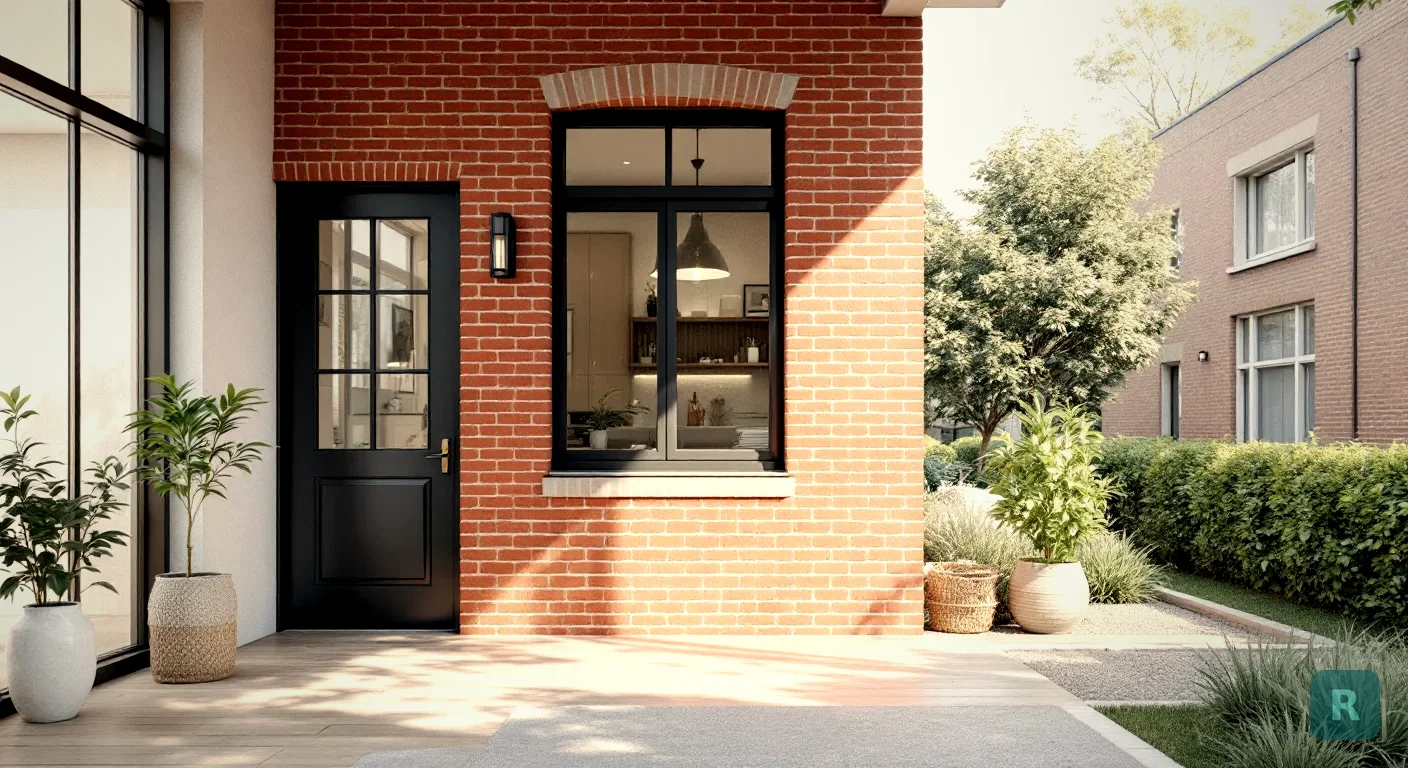
- Keep the brick when you can. Change the trim, door, windows and color around it, and test the look on a photo first.
The most expensive brick house mistake isn’t on the outside. It’s somebody planning a new window, an open wall or a spray foam job without knowing what the wall actually is.
A brick house looks simple from the street. It isn’t. The brick might be holding up the house, or it might be a skin hung on a wood frame, and those are two very different renovations.
I’m a third-generation carpenter, and I’ve worked on houses from Alaska to Hawaii to the Pacific Northwest. The rule I learned from my dad holds on every one of them: know what’s behind the surface before you price the job. This post is about how to do that on a brick house, and what to spend money on once you know.
Solid Brick or Veneer? Answer This First
There are two kinds of brick houses. Solid masonry means two or more layers of brick (or block with brick in front) carry the weight of the house. Brick veneer is one layer of brick tied to a wood or steel frame with metal ties. The frame carries the load and the brick is just siding.
Here’s how inspectors tell them apart, based on InterNACHI’s guide to solid brick vs veneer:
| Clue | Solid Brick | Brick Veneer |
|---|---|---|
| Header bricks (short end facing out) | Often a row of them every 6th course, sometimes 5th or 7th | None, every brick laid long side out |
| Weep holes at the bottom of the wall | Usually not | Yes, small gaps that let the cavity drain |
| Wall thickness at a window or door | Two bricks deep | One brick, then a gap, then framing |
| Age of the house | More common in older homes | Most newer brick houses |
One catch. Some solid walls use metal ties instead of header bricks, so they look like veneer from the outside. If the header test comes up empty on an older house, pull a switch plate on an exterior wall or look at the wall depth at a window before you assume.
Walk the house and look at the bottom row of brick, just above the foundation. Small open gaps every few feet are weep holes, a strong sign of veneer. Then look for a full row of short brick ends running across the wall. That points to solid brick.
What Solid Brick Changes Inside the House
On a veneer house, an exterior wall renovation is mostly a framing job. You open the drywall, work in the stud bays and close it up. On a solid brick house, the exterior wall is the structure, so a few jobs get harder and more expensive.
- New or bigger windows. Cutting into a load-bearing brick wall needs a lintel or steel above the opening, and often an engineer’s sign-off. Budget for it before you fall in love with a picture window.
- Wiring and outlets. There are no stud bays to fish wire through. Electricians often have to cut channels in the plaster and brick, or fur the wall out to make room.
- Insulation. This is the one people get wrong. Building Science Corporation’s research on masonry retrofits found that insulating a solid brick wall from the inside makes the brick colder and slower to dry, which raises the risk of freeze-thaw damage.
Interior insulation on solid masonry can work, but Building Science Corporation says the risk has to be assessed first, starting with an inspection by someone who knows building science. In a wet, cold climate, guessing wrong shows up as crumbling brick a few winters later.
This is the “hidden work will get you” lesson I’ve learned more than once on remodels. You can’t always see the problem until demo day. On a brick house, you at least know which question to ask up front.
Mortar Is the Part That Wears Out
Brick can last a very long time. The mortar between it is the sacrificial part, and it’s supposed to be. The National Park Service’s Preservation Brief 2 on repointing lays out the rules every mason should follow:
- New mortar must be softer than the brick. The wall moves with heat, cold and moisture. Soft mortar takes that stress. Hard mortar pushes it into the brick, which cracks and spalls, and that damage “cannot be repaired easily.”
- It also has to breathe. Mortar lets moisture move out of the wall. Seal that path with dense cement mortar and the water leaves through the brick face instead, popping the surface off.
- Old mortar comes out deep. Joints should be cleaned out to 2 to 2-1/2 times the joint width, usually about 1/2 to 1 inch on brick.
- A test patch comes first. The Brief suggests about a 3 foot by 3 foot sample panel to approve color, texture and joint shape before the whole wall gets done.
That number is why I’d never hire the cheapest mason on a brick house. A rushed job with hard, gray cement mortar on soft old brick doesn’t just look patchy. It can damage the brick you were trying to save.
Ask every bidder one question: what mortar will you use, and how will you match its strength to my brick? If they look at you funny, keep calling.
What Brick Repairs Cost
These ranges come from Bob Vila’s tuckpointing cost guide (updated December 2023). Masons and homeowners use “tuckpointing” and “repointing” for the same job, though technically tuckpointing is a decorative joint on top of a flush one.
That whole-house figure has a huge spread for a reason. A one-story ranch with a few bad joints along the gutter line is a small job. A two-story house that needs scaffolding on every side is a big one.
Most houses don’t need all of it at once. Repoint where the water hits hardest first: below gutters, around windows and at the chimney. If the chimney is the worst part, my chimney remodel post covers that job on its own.
Keep the Brick, Change What’s Around It
Here’s where a brick house is easier than most. The brick is the most expensive material on the outside, and you already own it. Tearing it off is rarely worth it. What usually dates a brick house is everything next to the brick.
None of that touches a single brick. Painting or limewashing brick is a bigger call, because once you paint brick you’re usually painting it forever. I walked through leave it, limewash it or paint it in my 70s house exterior makeover post, and the advice is the same here: try leaving it first.
If your brick house is pre-war, read my old house renovation post too. Older brick homes pile on plaster, old wiring and soft lime mortar all at once. For a long, low brick ranch, the ranch remodel post covers the inside of the house.
See the Whole House Before You Spend
Most homeowners can’t picture black trim on their red brick. They can’t picture a new door color against that brick either. Honestly, I couldn’t either without seeing it. For years my workaround was having clients scroll Pinterest, but that shows somebody else’s house, in somebody else’s brick.
That’s the gap ReVision AI fills. Take one photo of your house from the street and see your actual brick with new trim, doors and windows.
Stand across the street in daylight so the whole facade and roof are in the frame.
Run it through styles like Modern Farmhouse, Contemporary or Mid-Century Modern, or use a custom prompt like "black windows, white trim, keep the red brick."
Take that picture to your bids so every contractor is pricing the same scope.
You can see real before and after results in the gallery. Want to see what your brick house could look like? Download ReVision AI and try 3 free transformations.
If you’re still sorting out the bigger budget, my posts on the cost of renovating a house and small house renovation cover whole-house numbers. And if you want to compare tools, I’ve reviewed apps for house renovations and more apps for house renovation planning.
Your Brick House Renovation Checklist
- Check for header rows, weep holes and wall depth to figure out solid brick or veneer.
- If it's solid, talk to an engineer before cutting any new window or door opening.
- Don't insulate a solid brick wall from the inside until someone has assessed the freeze-thaw risk.
- Walk the house after a rain and mark wet, crumbling or missing mortar joints.
- Get repointing bids that name the mortar type and include a test patch.
- Repoint the worst areas first: below gutters, around windows and the chimney.
- Keep the brick. Picture new trim, windows, door and lighting on a photo of your house before you buy anything.
- Add 15 to 20% to the budget for what you find once the walls are open.
Get Design Inspiration Weekly
Fresh room makeover ideas, renovation tips, and style guides delivered to your inbox.
Design tips and inspiration only. Unsubscribe anytime.
Related Articles
House Modification for Aging in Place: What to Change, Room by Room
A house modification plan for aging in place: ramp math, door widths, first-floor living, kitchen changes and who helps pay, room by room, from a carpenter.
9 min readGAF Virtual Remodeler: How to Use It and What It Won't Tell You
How to use the GAF Virtual Remodeler to try shingle colors on a photo of your own house, the photo tips that matter, and what to check before you buy.
7 min readGreen Remodeling: What Actually Saves Energy, Water and Waste
Green remodeling from a third-generation carpenter: keep what works, fix the walls while they're open, pick efficient fixtures, and skip the eco upsells.
8 min read